
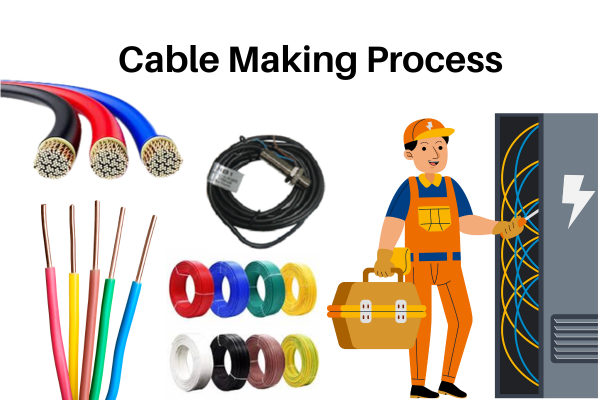
Cable Making Process: Step-by-Step Guide to Copper Wire and PVC Cable Manufacturing
The cable making process is a crucial part of the electrical and electronics industry. High-quality electrical cables ensure safe power transmission, durability, and long-term performance. This article explains the complete copper cable manufacturing process, from raw material to finished cable, in a simple and easy-to-understand way.
1. Copper Wire Drawing from 8mm Rod
The cable manufacturing process begins with electrolytic copper rods, usually of 8mm diameter. These rods are fed into a wire drawing machine, where the copper is drawn through a series of dies.
During this stage:
- The copper rod is reduced from 8mm to fine wire sizes
- Final wire diameter ranges between 0.1mm to 0.3mm
- The drawing process improves wire strength and conductivity
This step is critical because uniform wire size ensures consistent electrical performance in the final cable.
2. Wire Twisting and Bunching Process
After wire drawing, the fine copper wires move to the twisting or bunching process. In this stage, multiple copper wires are twisted together to form a single conductor.
Common bunching configurations include:
- 14 wires
- 16 wires
- 22 wires
- 32 wires
The bunching process:
- Improves cable flexibility
- Increases mechanical strength
- Ensures better current flow
This step is essential for producing multi-strand copper cables used in household, industrial, and commercial applications.
3. PVC Extrusion Process for Cable Insulation
Once the copper wires are properly bunched, they move to the PVC extrusion process. Here, the bunched copper conductor is coated with PVC insulation using an extrusion machine.
Key features of this stage:
- Cable size ranges from 1 sqmm to 6 sqmm
- PVC provides electrical insulation and safety
- Protects the cable from heat, moisture, and abrasion
The extrusion process ensures uniform insulation thickness, which is vital for meeting electrical safety standards.
4. Cable Cooling and Coiling
After PVC extrusion, the cable passes through a cooling system to stabilize the insulation. Once cooled, the finished cable is measured and cut into required lengths.
Standard cable coil lengths include:
- 30 meters
- 60 meters
- 90 meters
These coils are then bundled, packed, and prepared for distribution.
5. Applications of Manufactured Cables
Cables produced through this process are widely used in:
- Residential electrical wiring
- Industrial power systems
- Commercial buildings
- Control panels and machinery
The combination of fine copper strands and PVC insulation ensures high performance, safety, and durability.
Conclusion
The cable making process involves several precise and controlled steps, including copper wire drawing, wire bunching, PVC extrusion, and final coiling. Each stage plays a vital role in producing high-quality electrical cables that meet industry standards.
Understanding this process helps manufacturers maintain quality and helps buyers choose reliable and safe electrical cables for their applications.